Though Carl Orff (1895–1982) composed prolifically and made his mark as an educator (his influential system of active music pedagogy remains widely taught today) history remembers him above all as the man behind a single work: the mighty, monumental Carmina Burana, or Poems of Beuren.
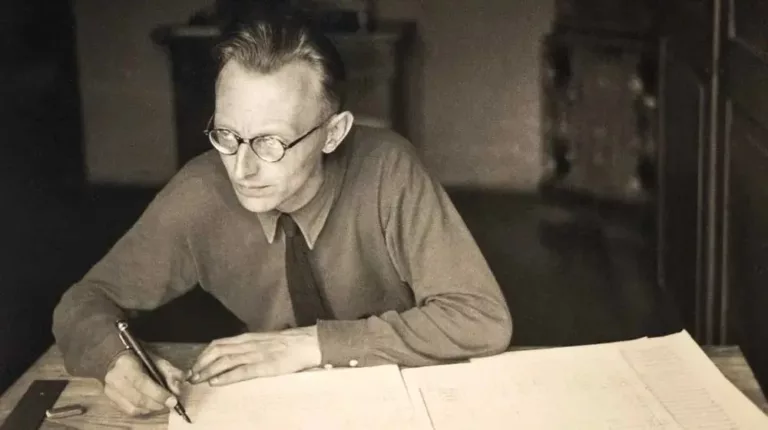
© Partial Gertrud Orff Bequest (Josef Willert/Archives : OZM), Carl Orff working on Carmina Burana, September 1936
Among the Benedictines of Beuren
Dusty remnants of ecclesiastical or scholastic Latin, perhaps? To stay as close as possible to the score’s medieval spirit, Orff gave it an expansively programmatic subtitle, ideal material for brushing up one’s grammar: Cantiones profanae cantoribus et choris cantandae comitantibus nimbus instrumentis atque imaginibus magis — which translates roughly as “Profane songs for singers and choirs to be sung with instruments and magic images.” Fair enough. But what of the epithet “Burana”? It points to the geographical source of the texts Orff drew on for his great choral fresco, composed between 1935 and 1936: 24 medieval poems taken from a collection discovered in 1803 at a Benedictine monastery in the Bavarian Alps, known as Beuren.
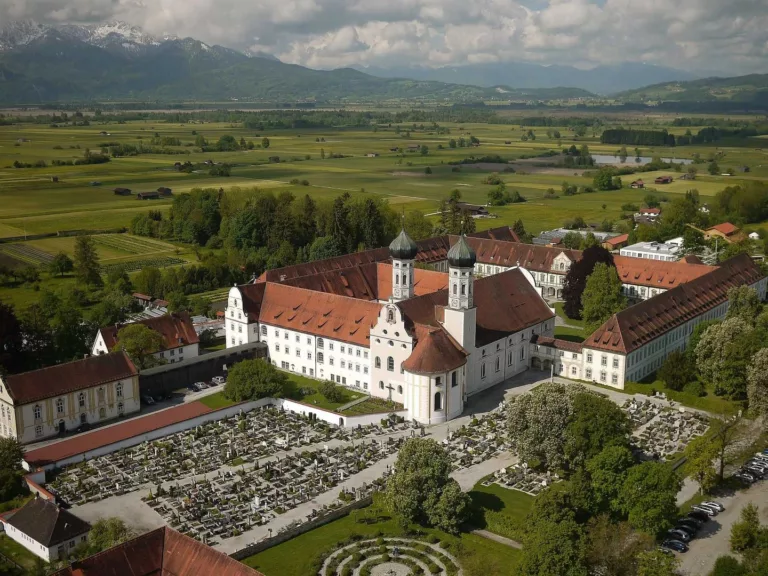
The pleasures of wine and love
Orff was not alone in navigating this exceptional source. Led to it by an 1884 translation of 46 poems by the British writer John Addington Symonds, published under the gloriously blunt title Wine, Women, and Song, he had the benefit of a young law student with a passion for Latin and Greek, Michel Hofmann, who played an active role in selecting and arranging the chosen poems.
“The songs — some two hundred in all — come from across Europe, written in either corrupt Latin, Middle High German, or very early French,” notes the French musicologist François-René Tranchefort in his Guide de la musique sacrée et chorale profane. “Sacred texts sit alongside hymns to the pleasures of wine and love, evocations of worldly vanity, and satires on the decline of morals — irony and crudeness mingled with spiritual elevation and reflections on the relentless wheel of fate.”
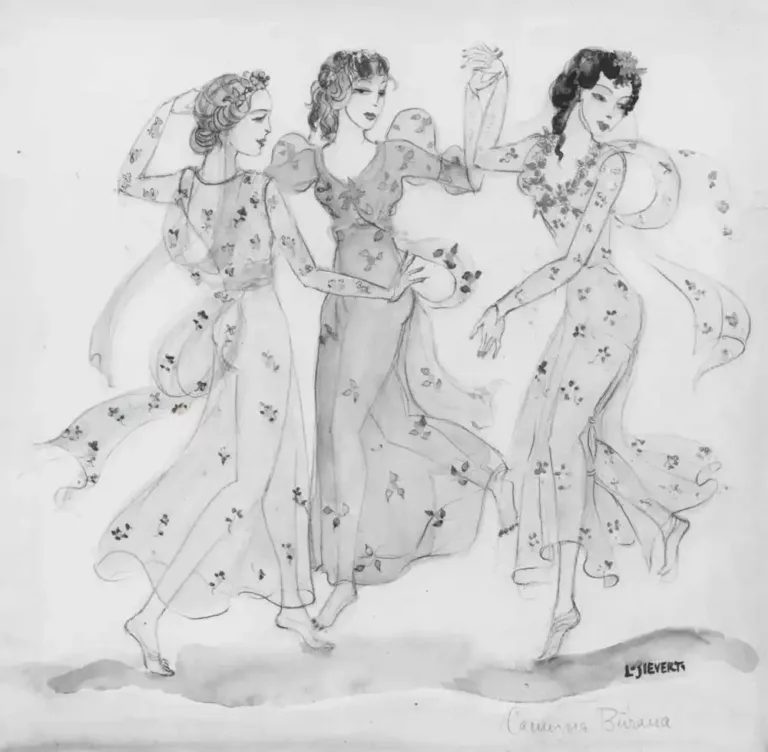
© COS/Archiv: costume sketch by Ludwig Sievert for the world premiere of Carmina Burana
“Fortune smiled on me when it placed a Würzburg antiquarian book catalogue in my hands, in which I found a title that drew me in with magical force: Carmina Burana.”
– Carl Orff
Rhythm and simplicity
The original melodies to which these texts were sung are lost to us, and Orff set them entirely afresh. The result would strike an immediate chord with audiences: rather than the pronounced complexity associated at the time with Schoenberg, Webern and Berg’s Second Viennese School, he embraced a direct musical language, rooted, as in Stravinsky, in rhythmic drive and the absence of lengthy development, and inspired more by Renaissance masters such as William Byrd and Claudio Monteverdi than by Gregorian neumes (as has sometimes been claimed, given the medieval origins of the poems).
“O Fortuna”
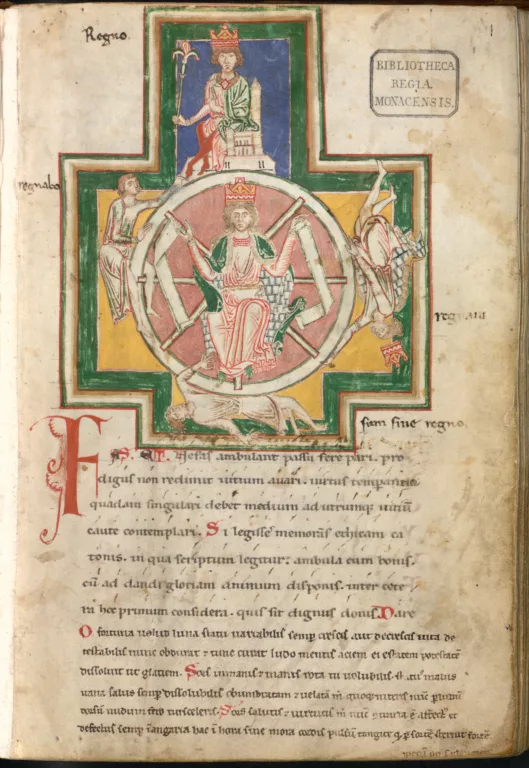
The cantata is built around five sections, each subdivided into several linked movements. The first is unquestionably the best known, so emblematic that it returns at the very end to crown a piece structured in the manner of a “Wheel of Fortune” (whose image adorns the cover of the manuscript): O Fortuna Imperatrix Mundi [O Fortune, Empress of the World]. It is followed by Spring [Primo vere], a celebration of nature’s renewal; a tavern scene (In Taberna) with its roster of drinking songs; a Court of Love unfolding a sequence of erotic songs; and finally a tableau entitled Blanziflor and Helena.
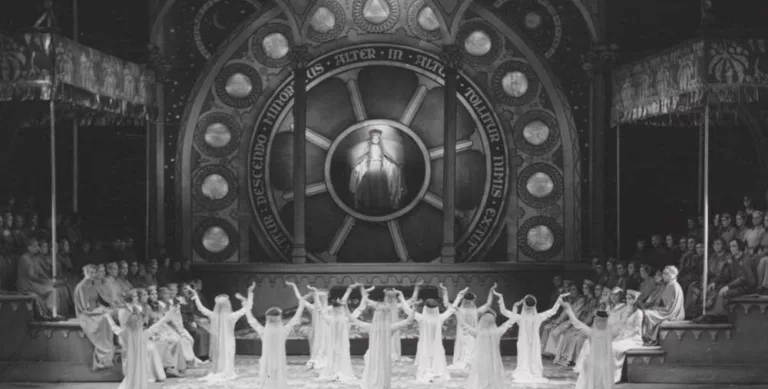
Production of Carl Orff’s Carmina Burana at the Württembergisches Staatstheater, Stuttgart, 27 February 1941
Triumph and appropriation
The premiere, on 8 June 1937 at the Frankfurt Opera, was a triumph. Despite the erotic content of some texts and the Russian influences that surface here and there, the National Socialist government then in power in Germany seized on Carmina Burana as a hymn to its regime — the composer having little say in the matter. This did nothing to hinder the cantata’s conquest of postwar audiences: it was performed in Israel as early as 1966.
A first for the Verbier Festival Junior Orchestra
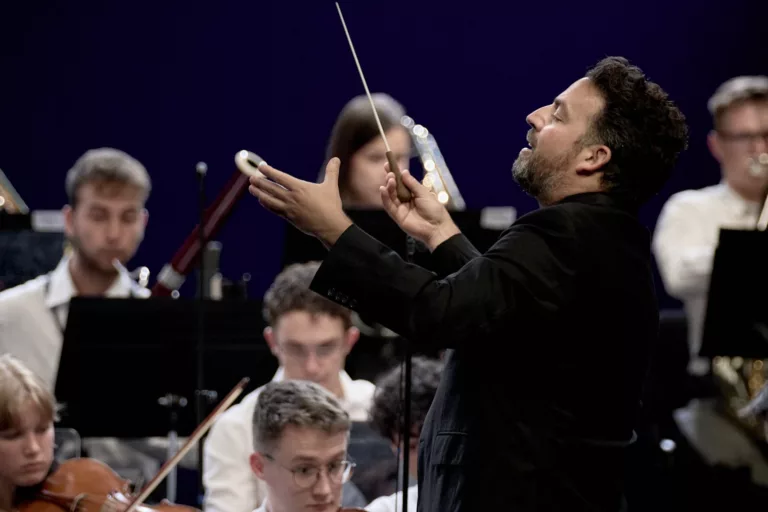
Carmina Burana is today a piece that brings people together — through its sheer power and immediate appeal — in the shared pleasure of performing and listening. A magnificent platform for communion between the young musicians of the Verbier Festival Junior Orchestra (VFJO) — appearing for the first time in an evening concert at the Salle des Combins — and the local Oberwalliser Vokalensemble, all under the expert direction of James Gaffigan, the VFJO’s Music Director since 2021 and Chief Conductor of the Komische Oper Berlin since 2023.
BOOK YOUR TICKETS