Mahler’s rightful place is among the heirs of the First Viennese School (Haydn, Mozart, Beethoven, Schubert) and the early German Romantics, with Mendelssohn, Schumann, Bruckner, Wagner. Like them, he found his natural terrain in the orchestral lied and, above all, the symphony.
Across ten monumental works, the last of them left unfinished, this son of a modest Bohemian innkeeper pushed the centuries-old form to its limits and beyond. From the orchestra, he sought to conjure a world without boundaries, one equal to his own stratospheric ambition.
Defying the “Indian sign”
Like Brahms before him, Mahler was haunted by the “ghost” of Beethoven and the “Indian sign” of the nine symphonies he could never quite escape. Yet this perfectionist felt sustained in his “mission” by Bruckner’s mysticism and Wagner’s legacy: Wagner’s gift for developing a musical idea held a particular fascination for him. In doing so, Mahler in turn opened the door to future revolutions, among them the Second Viennese School, which would finally shatter the constraints of tonality altogether.
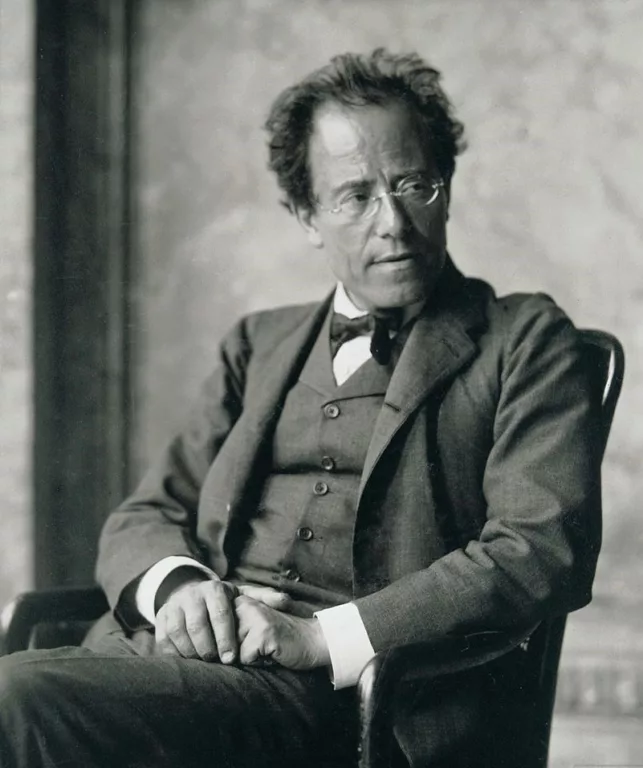
Gustav Mahler, photographed in 1907 by Moritz Nähr, as Director of the Wiener Hofoper (Wiener Staatsoper)
A belated renaissance, and a cinematic one!
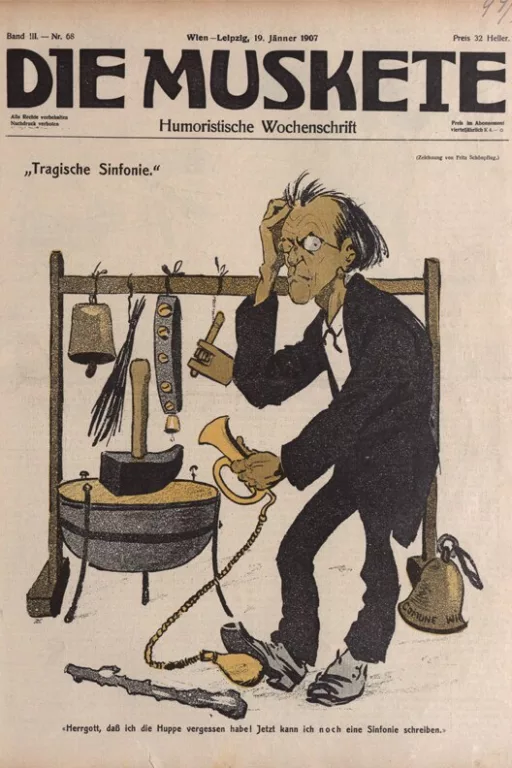
© Caricature of Mahler’s Sixth Symphony (1907): “My god, I forgot the car horn! Now I can write another symphony.”
Such visionary boldness comes at a price. In his relentless pursuit of a musical and expressive ideal — one that was, by definition, unattainable — Mahler kept returning to his scores, leaving performers lost in a thicket of competing editions. Listeners, too, can find themselves adrift before the sheer scale of his musical frescoes, populated as they are by unexpected instruments: guitar, mandolin, glockenspiel.
The musical language, in its proportions as much as its form, long baffled audiences in Latin countries, too quick to dismiss it as “Germanic pomp”, preventing many from appreciating the refinement of his counterpoint and the warmth of his folk influences. It would take more than half a century for his works to find their rightful place in concert halls. The turnaround owed much to the energy of conductors such as Leonard Bernstein and Bernard Haitink, but also to a cinematic nudge from Luchino Visconti, who in 1971 chose the languid Adagietto from the Fifth Symphony to score his iconic Death in Venice, after Thomas Mann.
The Sixth Symphony: back to classical form
For once, it is Mahler himself who gives his Sixth Symphony its nickname, “the Tragic”, conducting the premiere in 1906. Long considered the most forbidding of the nine, it is today celebrated by devotees as the most perfect one.
After pieces that fragmented the classical mould by weaving voices together with instruments, Mahler returns to the framework of the great classical tradition as Haydn had defined it: four movements, and a home key that is also the key of arrival — A minor, for Mahler the key of tragedy above all others.
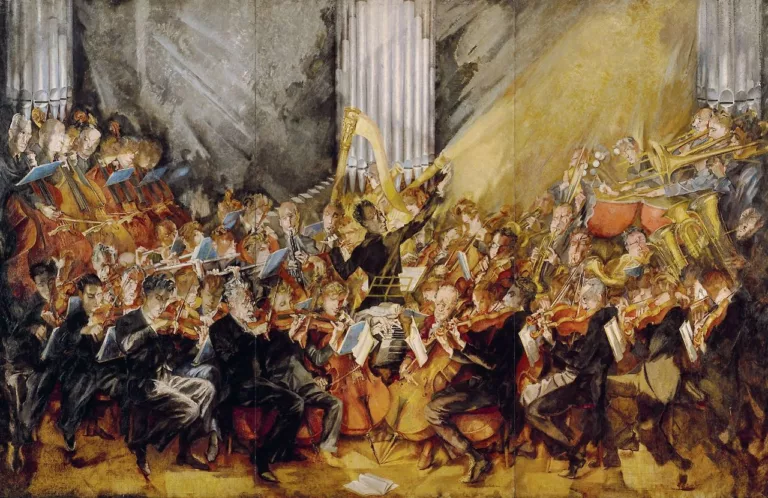
© Gustav Mahler conducting the Vienna Philharmonic Orchestra.Oil on Canvas by Max Oppenheimer, 1935
“His life in music”
The paradox is striking. In the summer of 1904, one of the happiest of his life, Mahler produced one of his darkest pieces. His wife Alma noted in her memoirs: “In the last movement, Mahler described himself and his downfall, or as he later said, that of his hero. ‘It is the hero on whom fall three blows of fate, the last of which fells him, as a tree is felled.’ Those were his words.”
With the Kindertotenlieder as with the Sixth, Alma tells us, he set his own life to music, anticipando. And indeed, Mahler calls for a special hammer to embody the blows of fate, as powerful in their symbolism as in their sound. The year after the premiere of his “Tragic” symphony, his daughter died, he was dismissed from his post at the Vienna Opera, and he was diagnosed with a heart condition.
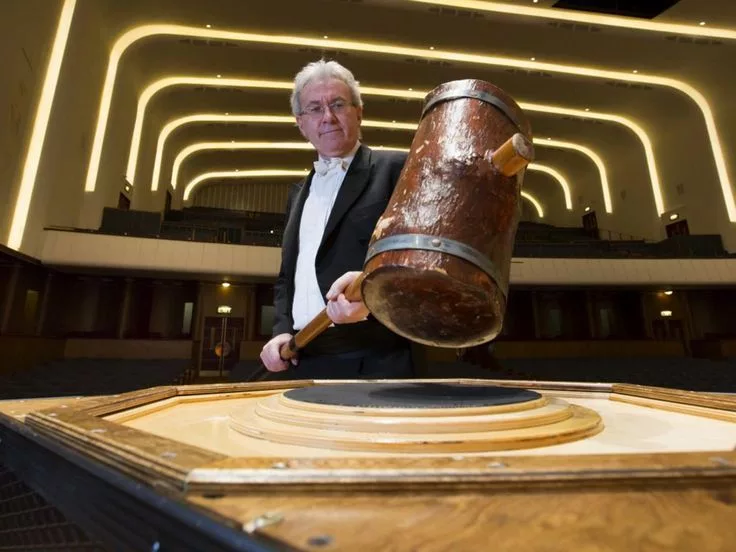
©Graham Jones from the Liverpool Philharmonic, The Independent
“A towering funerary monument to classical tonality”
The musicologist Marc Vignal offers a more detached reading, less biographical than Alma Mahler’s: “This Sixth Symphony is not a cry of despair, nor is it in any way elegiac. Dense, energetic, it bears witness to fierce struggles whose outcome, until the very last moment, seems uncertain. The ‘hero’ dies on his feet. The work is concise, lapidary — at once a masterpiece of logic and a masterpiece of passion. It is grandiose: a towering funerary monument to classical tonality, to its forms, to its thematic craft, and to the Romanticism of the 19th century.”
Under Gianandrea Noseda’s energetic baton
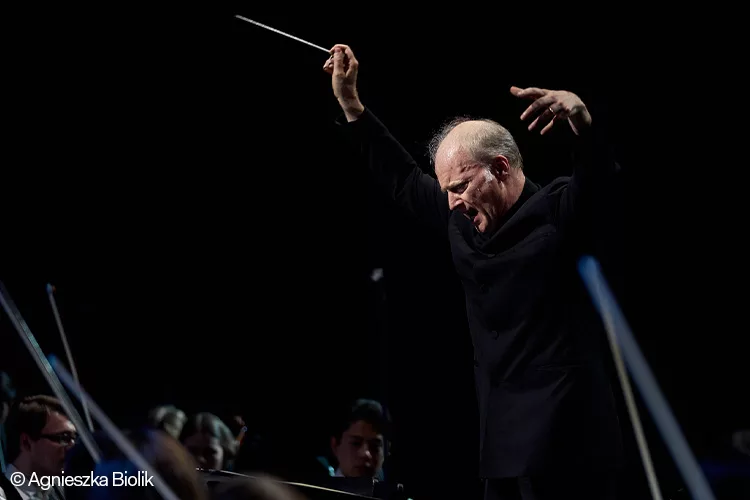
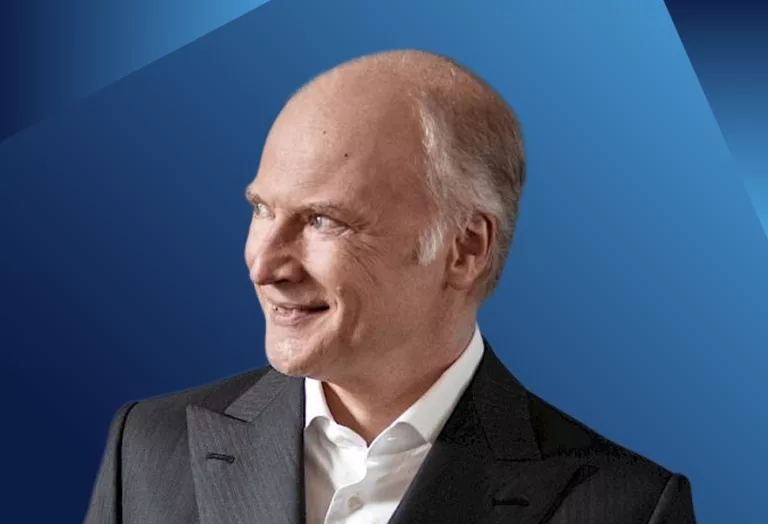
To conduct this monumental masterpiece, following Chopin’s Second Piano Concerto performed by Mikhail Pletnev, the Verbier Festival Orchestra will be joined by Italian conductor Gianandrea Noseda, well known to Swiss music lovers for his work in the pit at the Zurich Opera House since 2017. One of the 33rd edition’s highlights, not to be missed.
SYMPHONY NO. 6 “TRAGIC”
 Thursday, July 30, 2026, 6:30 PM to 9:00 PM
 Salle Des Combins