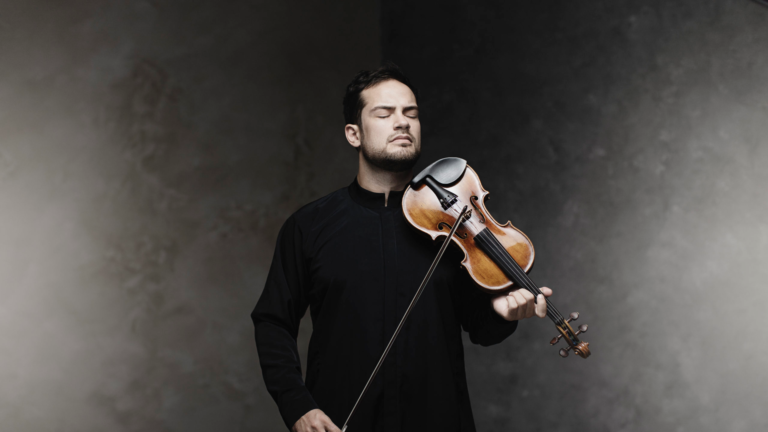
A horn player with the Orchestre de la Suisse Romande since 2014, Clément Charpentier-Leroy is also a member of the Lucerne Festival Orchestra and a founding member of the horn quartet HORNormes.

A graduate of the Conservatoire National Supérieur de Musique et de Danse de Paris, the Université Paris-Sorbonne as well as the Haute Ecole de Musique de Genève and laureate of the Chieri International Competition, Clément had the opportunity to travel throughout Europe and Asia during his studies, being invited by youth orchestras such as the European Union Youth Orchestra, the Gustav Mahler Jugendorchester or the Schleswig-Holstein Musik Festival.

He is now regularly invited to perform with prestigious European orchestras such as the London Symphony Orchestra, the Verbier Festival Chamber Orchestra, the NDR Elbphilharmonie Orchester, the Tonhalle-Orchester Zürich and the Orchestre de Paris, under the baton of the greatest conductors including Klaus Mäkelä, Riccardo Chailly, Yannick Nézet-Séguin, Antonio Pappano, Daniel Harding and Myung-Whun Chung.

His keen interest in teaching led him to take on the role of tutor for the Diploma of Advanced Studies at the OSR. He is regularly asked to tutor students’ dissertations at Geneva’s Haute Ecole de Musique, where he will take up the post of horn professor in 2023-2024. Clément also coaches the Verbier Festival Junior Orchestra.

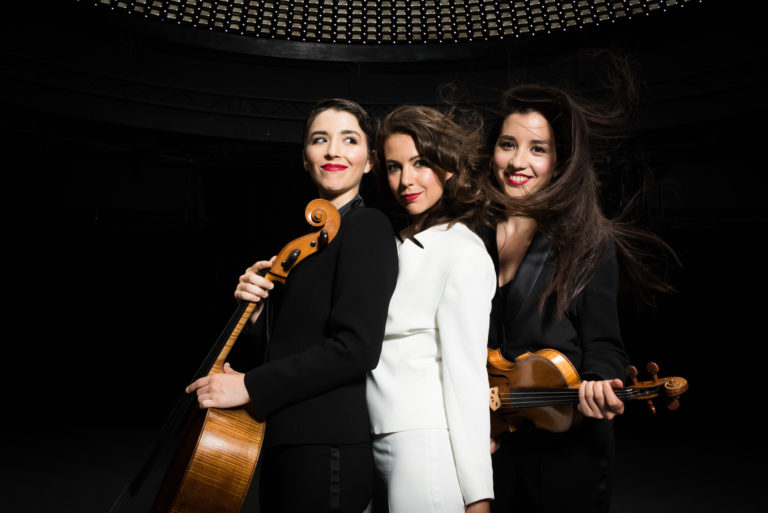
The Amatis Trio was founded in Amsterdam in 2014 by German violinist Lea Hausmann, British cellist Samuel Shepherd and Dutch/Chinese pianist Mengjie Han.

Only weeks after forming, the trio won the audience prize in Amsterdam’s Grachtenfestival- Concours, which quickly led to their debut in Amsterdam’s Concertgebouw Hall – to which they returned in 2018/19 season as ECHO (European Concert Hall Organisation) Rising Stars artists.

Between 2016 – 2018 the Amatis Trio were selected by BBC Radio 3 on to the BBC New Generation Artists scheme. In Spring 2020 the Amatis were awarded a Fellowship from the Borletti-Buitoni Trust at the same time that their debut disc on the AVI label was released featuring works of Enescu, Britten and Ravel.

​The Amatis Trio today emerges as one of the leading piano trios among the new generation. Their commitment to new music, bringing lesser known trio works to more prominence (as reflected in their debut disc) to education projects and bringing Western music to audiences less exposed has led the Trio to undertaking tours in 2018 to Abu Dhabi and India to where they would have returned (including to Mumbai’s National Centre for the Performing Arts) had the Corona Virus pandemic not prevented it. Also In 2020 the Trio were appointed to the Irene R. Miller Piano Trio Residency at the University of Toronto’s Faculty of Music and they are Resident Faculty Chamber Ensemble at Cambridge University.

After concluding their season as ECHO Rising Stars in 2019/20 season which saw the Trio perform in Europe’s major concert halls the Amatis Trio return to London’s Wigmore Hall, Edinburgh, Barcelona’s L’Auditori and Dortmund’s Konzerthaus. The Trio also appear for the Norfolk and Norwich, Champs Hill, and Malvern concert societies in the UK and make a return tour to Sweden.

Summer 2019 saw the Amatis Trio make their BBC Proms debut and with the Royal Philharmonic Orchestra under the baton of Jamie Phillips at the 2019 Kings Lynn Festival. In an “Amatis and Friends” programme they made their 2019 Edinburgh International Festival debut. In 2020 the Trio will return to the Mecklenberg Vorpommern Festival.

The Amatis Trio’s commitment to contemporary music led to the foundation in 2015 of the ‘Dutch Piano Trio Composition Prize’. Encouraging young composers to expand the piano trio repertoire they have most recently premiered a piano trio, “Moorlands”, from swedish composer Andrea Tarrodi.

Since 2015 the trio has worked intensively with Wolfgang Redik (Vienna Piano Trio) and Rainer Schmidt (Hagen Quartet) and is currently enrolled in the Piano Trio Master Studies at the Mozarteum University in Salzburg. The Trio is part of the European Chamber Music Academy.​

Other important musical influences include Hatto Beyerle, the Trio Jean Paul, Lukas Hagen, Fabio Bidini, Ilya Grubert, Anner Bylsma, Christian Schuster, Ib Hausmann, Imre Rohmann, Menahem Pressler and Sir András Schiff, with whom they worked at the Artists Academy Verbier.​

Other prize-winning accolades include the 2018 Melbourne International Chamber Music Competition, the 2015 International Parkhouse Competition at the Wigmore Hall, 2nd prize winners of the International Joseph Joachim Competition in Weimar, Germany and they were named Dutch Classical Talent in 2015/2016.

He was born Peter Alexander Freiherr von Ustinow on April 16, 1921 in Swiss Cottage, London, the son of Nadezhda Leontievna (Benois) and Jonah Freiherr von Ustinow. His father was of one-quarter Polish Jewish, one-half Russian, one-eighth Ethiopian, and one-eighth German descent, while his mother was of one-half Russian, one-quarter Italian, one-eighth French, and one-eighth German ancestry. Ustinov had ancestral connections to Russian nobility as well as to the Ethiopian Royal Family. His father, also known as “Klop”, was a pilot in the German Air Force during World War I. In 1919, Peter’s father joined his own mother and sister in St. Petersburg, Russia. There he met his future wife, artist Nadia Benois, who worked for the Imperial Mariinsky Ballet and Opera House in St. Petersburg. In 1920, in a modest and discreet ceremony at a Russian-German church in St. Petersburg, Ustinov’s father married Nadia. In February 1921, when she was seven months pregnant with Peter, the couple emigrated from Russia in the aftermath of the Communist Revolution.

Young Peter was brought up in a multilingual family. He was fluent in Russian, French, Italian and German, as well as English. He attended Westminster College (1934-37), took the drama and acting class under Michel St. Denis at the London Theatre Studio (1937-39), and made his stage debut in 1938 in a theatre in Surrey. The following year, he made his London stage debut in a revue sketch, then had regular performances with Aylesbury Repertory Company. In 1940 he made his film debut in Hullo, Fame! (1940).

From 1942 to 1946 Ustinov served as a private soldier with the British Army’s Royal Sussex Regiment. He was batman for David Niven, and the two became lifelong friends. Ustinov spent most of his service working with the Army Cinema Unit, where he was involved in making recruitment films, wrote plays and appeared in three films as an actor. At that time he co-wrote and acted in L’héroïque parade (1944) (aka “The Immortal Battalion”).

Ustinov had a stellar film career as actor, director, and writer. Among his numerous screen acting gems were his unparalleled, Academy Award-nominated interpretation of Nero in Quo Vadis (1951) and roles in Max Ophüls’s masterpiece Lola Montès (1955), Barefoot in Athens (1966), Les comédiens (1967), Robin des Bois (1973) and L’Âge de cristal (1976). He also wrote and directed such brilliant films as Billy Budd (1962), Lady L (1965) and Memed My Hawk (1984). He was awarded two Oscars for Best Supporting Actor, one for his role in Spartacus (1960) and one for his role in Topkapi (1964), and received two more Oscar nominations as an actor and writer. His career slowed down a bit in the 1970s, but made a comeback as Hercule Poirot in Mort sur le Nil (1978) by director John Guillermin. In the 1980s, Ustinov recreated Poirot in several subsequent television movies and theatrical films, such as Meurtre au soleil (1982) and Rendez-vous avec la mort (1988), while his cinema work in the 1990s also includes his superb performance as Professor Gus Nikolais in George Miller’s excellent dramatic film Lorenzo (1992), a character partially inspired by Hugo Wolfgang Moser, a research scientist who had been director of the Neurogenetics Research Center at the Kennedy Krieger Institute and Professor of Neurology and Pediatrics at Johns Hopkins University.

His expertise in dialectic and physical comedy made him a regular guest of talk show hosts and late-night comedians. His witty and multidimensional humor was legendary, and he later published a collection of his jokes and quotations summarizing his wide popularity as a raconteur. He was also an internationally acclaimed TV journalist. Ustinov covered over 100,000 miles and visited more than 30 Russian cities during the making of his well-received BBC television series Russia (1986).

In his autobiographies, “Dear Me” (1977) and “My Russia” (1996), Ustinov revealed his observations on his life, career, and his multicultural and multi-ethnic background. He wrote and directed numerous stage plays, successfully presenting them in several countries. His drama, “Photo Finish”, was staged in New York, London and St. Petersburg, Russia, where Ustinov directed the acclaimed production, starring Elena Solovey and Pyotr Shelokhonov.

In addition to his acting and writing, Ustinov served as a Goodwill Ambassador for UNICEF and a president of WFM, a global citizens movement. He was knighted in 1990. From 1971 until his death in 2004, Ustinov lived in a château in Bursins, Vaud, Switzerland. He died of heart failure on March 28, 2004, in a clinic in Genolier, Vaud, Switzerland. His funeral service was held at Geneva’s historic Cathedral of St. Pierre, and he was laid to rest in the village cemetery of Bursins. He was survived by three daughters (Tamara, Pavla, and Andrea) and one son (Igor). His epitaph may be gleaned from his comment, “I am an international citizen conceived in Russia, born in England, working in Hollywood, living in Switzerland, and touring the World”.

In 2011, Alain Dufaux  joined the MetaMedia Center (MMC) launched by the Vice-Presidency for Innovation and Valorization (VPIV) at EPFL (Swiss Federal Institute of Technology, Lausanne, Switzerland). Acting as project manager, his activity was split between the operational tasks of the Montreux Jazz Digital Project, and the numerous innovation projects initiated by the MMC in partnership with the labs of EPFL working around acoustics, signal processing or multimedia. Since 2014, he is the operation & development director of the Metamedia Center, renamed Cultural Heritage & Innovation Center in 2020.

Born in 1996 in Geneva, Gabriel Esteban grew up in a family of musicians. After studying with François Abeille, he benefited from the teaching of François Guye at the Haute École de Musique de Genève and is currently studying with Giovanni Gnocchi at the Mozarteum in Salzburg. At the same time, he received advice from cellists such as Christophe Coin, Marc Coppey, Enrico Dindo, David Geringas, Thomas Grossenbacher, Frans Helmerson, Clemens Hagen, Gary Hoffman, Maria Kliegel, Reinhard Latzko, Philippe Muller, Raphaël Pidoux, Troels Svane, István Vardái and Wen-Sinn Yang. Gabriel Esteban won the 2nd prize at the David Popper International Competition in Hungary, numerous 1st prizes at the Swiss Youth Music Competition, where he also received the SUISA Foundation prize for the best interpretation of a work by a Swiss composer, and was also a laureate of the Enrico Mainardi Competition in Austria. He has been invited to perform at the Festival Lavaux Classic with Tedi Papavrami, at the Kronberg Academy with Jehye Lee and István Várdai and regularly gives recitals in Switzerland, Austria and Italy. As a soloist, he has already performed with several orchestras in Europe and will tour with the Swiss Youth Symphony Orchestra in 2019 in some of the country’s largest concert halls. Gabriel Esteban is the cellist of the Aurora Piano Quartet, the first piano quartet in residence at the Queen Elisabeth Music Chapel in Belgium. The ensemble performs regularly in concerts in Switzerland, France, Belgium and Austria. The quartet works regularly with members of the Artemis, Danel, Ébène, Takács and Ysaÿe quartets, the Trio Wanderer, as well as with Nobuko Imai, Tedi Papavrami, Jean-Claude Pennetier and Pavel Vernikov. Winner of the Illzach International Chamber Music Competition and the Orpheus Chamber Music Competition, the ensemble toured Brazil and Argentina in 2016. The Aurora Piano Quartet has been invited to perform at the Festival de Piano de la Roque d’Anthéron, the Swiss Chamber Music Festival, the Académie Villecroze and the Festival Piano à Porrentruy. Gabriel Esteban has been principal cellist of the Verbier Festival Orchestra and the Swiss Youth Symphony Orchestra. He has performed with conductors such as Charles Dutoit, Iván Fischer, Valery Gergiev, Daniel Harding, Manfred Honeck, Paavo Järvi, Jesús López-Cobos, Zubin Mehta, Gianandrea Noseda, Esa-Pekka Salonen, Michael Tilson Thomas and is a regular member of various Swiss orchestras.

Nathalie Stutzmann has just been announced as the Philadelphia Orchestra’s new Principal Guest Conductor from season 21/22. The three-year tenure will involve a regular presence in the orchestra’s subscription series in Philadelphia and at its Summer festivals in Vail and Saratoga. Nathalie is also entering the third season of a highly successful tenure as Chief Conductor of the Kristiansand Symphony Orchestra, a tenure which has just been extended by a further two seasons, to the end of 22/23.

Nathalie Stutzmann is considered one of the most outstanding musical personalities of our time. Charismatic musicianship, combined with unique rigour, energy and fantasy, characterise her style. A rich variety of strands form the core of her repertoire: Central European and Russian romanticism is a strong focus — ranging from Beethoven, Schumann, Brahms and Dvorak through to the larger symphonic forces of Tchaikovsky, Wagner, Mahler, Bruckner and Strauss — as well as French 19th century repertoire and impressionism. Highlights from her partnership with the Kristiansand Symphony Orchestra include acclaimed performances of Bruckner’s Symphony No.7, Tchaikovsky’s Symphony No.6 and a complete cycle of Beethoven’s symphonies.

Nathalie was also Principal Guest Conductor of the RTE National Symphony Orchestra of Ireland 2017-2020. Her sold-out performances with the RTE NSO in Dublin attracted outstanding accolades from the press, with particular praise for her performances of Strauss’s Also sprach Zarathustra, Tchaikovsky’s Symphony No.5, and Mahler’s complete Das Knaben Wunderhorn.

As a guest conductor, Nathalie began the season 20/21 with the Royal Stockholm Philharmonic Orchestra and returns to them twice during the season. Other guest conducting highlights over the next two seasons include performances with the Philadelphia Orchestra, Atlanta Symphony, San Francisco Symphony, Minnesota Orchestra, Los Angeles Philharmonic, Seattle Symphony, Pittsburgh Symphony, Orchestre Métropolitain Montreal, NDR Elbphilharmonie, London Symphony, Royal Liverpool Philharmonic, Orchestre National de Lyon, Orquesta Nacional de España and Finnish Radio Symphony.

Nathalie has also established a strong reputation as an opera conductor. She will open her 21/22 season with a conducting debut at the Metropolitan Opera (Iphigenie en Tauride). Last season she was due to conduct Tchaikovsky’s Pikovaya Dama at La Monnaie in Brussels (cancelled due to COVID-19), which has now been re-scheduled in 22/23. In recent years she conducted critically acclaimed performances of Wagner’s Tannhäuser (2017, Monte Carlo Opera), Boito’s Mefistofele (2018 Chorégies d’Orange festival in Provence).

Nathalie started her studies at a very young age in piano, bassoon, cello and studied conducting with the legendary Finnish teacher Jorma Panula. She was mentored by Seiji Ozawa and Sir Simon Rattle who says that “Nathalie is the real thing. So much love, intensity and sheer technique. We need more conductors like her”. Nathalie continues to keep a few projects as a singer each season, primarily recitals and performances with her own ensemble. In January 2019 she was elected a Chevalier in the ‘Ordre National de la Légion d’Honneur’, France’s highest honour. France had previously honoured her unique contribution to the country’s cultural life by electing her ‘Commandeur des Arts et Lettres’ and ‘Chevalier de l’Ordre National du Mérite’.

Nathalie is an exclusive recording artist of Warner Classics/Erato. Her next album, Contralto, will be released in January 2021.

James Garnon trained at Royal Academy of Dramatic Art and Edinburgh University. He has performed in over 20 productions at Shakespeare’s Globe, most recently in the main house as Touchstone in As You Like It and in the title role in Pericles in the Sam Wanamaker Playhouse. He is a Globe Associate Artist and a member of the Higher Education Faculty for whom he has taught both actors and directors. He has also frequently acted for the Royal Shakespeare Company, was a founder member of The Factory Theatre Company, and has performed at numerous other theatres including the Old Vic and Almeida Theatre. Aside from varied film and television work, James has also regularly worked as a masterclass leader for the Samling Artist Programme and Samling Academy.

Born in a Hindu Brahmin family in Northeast India, Tapashi Devchoudhury was introduced to asanas by her father, and the wisdom of Vedic mantras and ancient Hindu philosophies by her mother very early in her life. The ancestral teachings of oriental philosophies and a fascination towards the human consciousness led to her exploring deeper connections between the body-mind and consciousness. She leads a meditative and fluid yoga session, blending traditional hatha yoga with Tai-chi and Qi Kung. Tapashi believes that ‘Yoga’ cannot be taught, it can only be experienced. Her classes intend to make this experience accessible.

He has played as a soloist with a number of orchestras, including the Academy of St Martin in the Fields, the Russian National Orchestra conducted by Mikhail Pletnev, the Polish Radio Orchestra, the Belgrade Philharmonic, the Lausanne Chamber Orchestra. His passion for chamber music has led him to the world’s most famous festivals, such as Marlboro, Verbier, Bergen, Gstaad, where he performed with artists such as Itzhak Perlman, Mitsuko Uchida, Nobuko Imai, Pierre Amoyal or with his Duo partner pianist Louis Schwizgebel. He has also been invited to perform with the Berlin Philharmonic and with the 12 cellists of this legendary orchestra.

Winner of the Swiss Ambassador’s Award, Lionel Cottet has received numerous prizes at international competitions including Lutoslawski Competition in Warsaw, Brahms Competition in Austria and Astral Artist Auditions in Philadelphia. He is also a Soloist of the swiss Migros Kulturprozent Classics and was finalist at the Eurovision competition.

He studied in the prestigious Artist Diploma program of the Juilliard School in New York, at the Salzburg Mozarteum, at the Zurich Hochschule and at the Geneva Conservatoire with Joel Krosnick, Clemens Hagen, Thomas Grossenbacher and François Guye.

Lionel is deeply committed to communicating with the young generation in various outreach programs in Mexico, Colombia, USA and in Switzerland. He plays an 1852 Jean-Baptiste Vuillaume cello.

The German tenor Gerhard Siegel began his musical career as an instrumentalist and composer. After completing his voice training with Liselotte Becker-Egner at the Augsburg Conservatory, he became an ensemble member of the Stadttheater Trier. Here the stage version of Heinrich Heine’s “Deutschland – ein Wintermärchen”, for which he composed the music, had its world premier. In 1995 Gerhard Siegel was the winner at the International Hans Gabor Belvedere Singing Competition in Vienna. After an engagement as dramatic and lyric tenor at the Anhaltisches Theater Dessau and guest performances in Germany, Bulgaria, Holland and Spain, he was engaged in Augsburg in 1997.

In 1998 he debuted at the Bavarian State Opera in Munich. From 1999 to 2006 he was under contract at the Nuremberg Theater, where he was primarily able to expand his repertoire in the field of dramatic and heroic tenor. Here he sang Parsifal, Bacchus, Herodes, Florestan, Laca (“Jenufa“) and Sergej (“Lady Macbeth of the Mtsensk District”), but also Mephistopheles (“Doctor Faust” by Busoni), Tom Rakewell and Alfredo. He won special acclaim for his debut as Stolzing (“Meistersinger”) and in the title role of “Siegfried”.

As a freelance singer since 2006, Gerhard Siegel has made guest appearances as Max in the new production of Weber’s “Freischütz” at the Comic Opera Berlin, in Hindemith’s “Nusch-Nuschi” under Gerd Albrecht and as Max in “Jonny spielt auf” in Cologne, as Florestan at the Granada Festival, as Weill’s “Protagonist” at the Bregenz Festival, as Herodes at the Opéra Montpellier and at the Vienna State Opera, as Hauptmann (“Wozzeck”) at Teatro Real Madrid, at the Opéra Bastille in Paris, at Covent Garden London and at the Met New York, in Zemlinsky’s “Traumgörge” at the Deutschen Oper Berlin and as Sellem in “The Rake’s Progress” at the Theater an der Wien, “Lulu” in Geneva and Madrid, Schuiskij in „Boris Godunow“ in Munich .A central role in his repertoire today is Mime in “Rheingold” and “Siegfried”. He sang the part on the occasion of his debuts at the Metropolitan Opera New York, at the Bayreuth Festival and at the Covent Garden in London, in the “Ring” directed by Jeffrey Tate at the Cologne Opera, and also at Covent Garden London and under Jun Markel in Tokio.

Another artistic highlight was Schönberg’s “Gurrelieder” (Klaus-Narr) on a tour with Michael Gielen and the SWR Symphony Orchestra and his debut with “Tristan and Isolde” and “Mahagonny” in Augsburg.

After Mime in “Rhinegold” and “Siegfried” in Barcelona, Dresden, New York and Tokyo, “Lulu” in Amsterdam, “Wozzeck” (Captain) in Chicago and Salzburg (Festival), Prince Schuiskij in “Boris Godunow” in Munich, “Herod” at the Vienna State Opera, Zurich Opera House, with the Boston Symphony Orchestra and at the Verbier Festival conducted by Charles Dutoit and Midas in “The Love of Danae” at the Salzburg Festival, 2017 still has in store the Witch at the Metropolitan Opera New York.

The next years will see the “Ring” in Dresden and “Salome” at the Berlin State Opera, “Tristan” in Cleveland and song recitals in New York, Staunton/Virginia and Texas. “Salome” in Budapest, the “Ring” as well as the Witch in London. Also planned: “Wozzeck” in New York, the “Ring” in Paris, “Le Grand Macabre” in Dresden.